Unionized workers at The Globe and Mail voted Thursday to approve a new contract.
About 84 per cent of those voting backed the deal.
Unionized workers at The Globe and Mail voted Thursday to approve a new contract.
About 84 per cent of those voting backed the deal.
Source: j-source.ca
The union representing Globe and Mail employees said the company must stop pointing the finger at them for its financial struggles.
“There is no denying The Globe is struggling, perhaps failing financially. We get it. But a blame-shifting approach won’t fix The Globe’s very serious problems,” said Sue Andrew, unit chair at the Southern Ontario Newsmedia Guild in a memo obtained by Christine Dobby at the Financial Post. “Characterizing Globe employees as having a sense of entitlement and suggesting that the collective agreement is somehow impeding the company’s success is negative, confrontational and counterproductive.”
Source: mediaunion.ca
The Kennedy Heights printing plant will be put up for sale immediately and operations there will cease sometime in 2015, the union was told today by Paul Godfrey, CEO of Postmedia.
The company presented two possible options going forward. One is contracting out the work currently done at Kennedy Heights. The company has “entered into a contract with Transcontinental” to print papers effective early 2015, Godfrey told Local 2000 representatives.
The other option is the union and company reaching an agreement to open a new plant that would cost substantially less to operate than Kennedy Heights. Godfrey explained that the contract between Postmedia and Transcontinental will not go into effect if the company and union reach a deal before Nov. 18, 2013 that reduces costs at a new plant by 70-75 percent.
Our current contract language says “there will be no involuntary loss of employment of any regular employee during the life of the contract as a result of” contracting out.
Union officers will be consulting with our legal counsel and meeting with members to discuss our next steps.
The company said it was hoping to have further discussions soon.
Postmedia also announced today that it is selling the Calgary Herald building and land and will be contracting out printing beginning in November.
Source: theglobeandmail.com
A Conservative bill that would force unions to open their books to the public is running into resistance from an unlikely source: Conservative senators.
Senate sources say between 15 and 25 Conservative senators are leaning toward supporting amendments to the bill, a move that would have the effect of preventing it from becoming law before the summer recess.
Source: mediaunion.ca
Bargaining between Local 2000 and Black Press Lower Mainland was suspended Tuesday after company negotiators, for the second time, presented the union with a proposal for a five-year contract with no general wage increases.
The company has proposed a one-time lump sum payment of 1% effective April 1, 2013, but only to employees at the top of their pay scale, prorated on an employee’s fulltime equivalency. In addition the company has proposed a one-time lump sum payment of 1.5% effective April 1, 2014, but only to employees at the top of their pay scale, prorated on an employee’s fulltime equivalency.
Under this company proposal there would be no general increases to the wage grid in the five-year period between April 1, 2010 and March 31, 2015.
The company is saying it needs this freeze in the wage grid in order to compete with wages paid at Glacier Media.
The company did agree to getting rid of the bottom rung of the bindery wage grid, which would have the effect of changing the starting rate from $10.58 per hour to $12.08 per hour. This would only affect new bindery employees and those currently paid $10.58 per hour.
The company also agreed to change the Shipper/Receiver rate to the same grid as General Clerk. This change would see the top rate for that job increasing from $17.98 per hour (after 2 years) to $19.74 per hour (after 4 years).
Under the company proposal there would also be a few minor concessions. The joint composing room board for Tri-City/Maple Ridge/Burnaby/New West would be split into three boards. As well the company is asking for a weakening of our “hot goods” clause in the contract.
Your bargaining committee believes the company’s general wage proposal to be unacceptable. It has decided to spend the next two weeks consulting with the membership.
Please email Vice President Gary Engler at gengler@mediaunion.ca with your comments or questions or talk to one of the bargaining committee members.
Members of your bargaining committee are:
Debbie Irvine — Abbotsford bindery
Jessica Unger — Campbell Heights bindery
Channy Dhillon — Abbotsford pressroom
Eileen Jarrett — Peace Arch News composing
Rich Weldon — Langley composing
Bonnie Pierotti — Abbotsford classified
Phil Melnychuk — Maple Ridge editorial
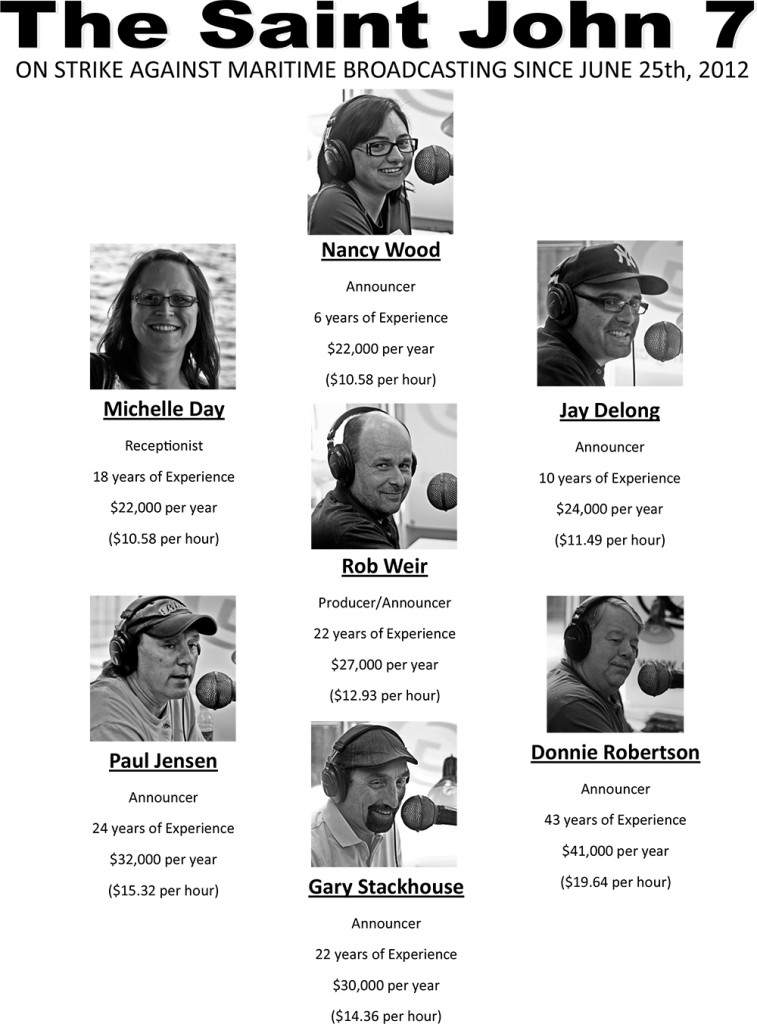
The striking Saint John seven announced today they are expanding their fight for a fair deal with their employer, Halifax-based Maritime Broadcasting System. They are asking listeners and advertisers of the Halifax MBS Radio stations, FX 101.9 and HAL-FM, to boycott the stations until the strikers reach a deal with the company.
Click link to read the entire story
A Tentative Agreement has been reached between the Victoria Joint Council of Newspaper Unions and the Times Colonist.
The Joint Council and Company agreed on a four year contract which will expire on January 2, 2015.
There were no concessions.
Term:
2011 0%
2012 0%
December 1, 2012 $250.00 signing bonus
January 2 2013 1%
January 2, 2014 1.5%
All Unions within the Joint Council will hold ratification vote meetings this week.
The Guild will hold their ratification vote meetings this Thursday, October 11 at 12:00 p.m. and 5:15 p.m. at the Guild Office.
The Tentative Agreement will be posted on Guild Bulletin boards tomorrow morning.
Enjoy your weekend.
Victoria Joint Council of Newspaper Unions.
Source: cepr.net
Washington, D.C.
Unionization in the United States has been on the decline since the 1960s. While many reasons have been offered to explain this drop in the rate of unionization, a new report from the Center for Economic and Policy Research highlights the roles that employer opposition to unions and weak labor laws have played in this decline.
The report, “Protecting Fundamental Labor Rights: Lessons from Canada for the United States,” begins with a comparison of the current state of organized labor in the United States and Canada. It notes that, from the 1920s to about 1960, Canada and the United States had roughly the same unionization rates. But in 1960, the two began to diverge. As of 2011, the unionization rate in Canada stood at 29.7 percent, compared to less than half that in the U.S., at 11.8 percent.
The paper then goes on to look at the legal process for forming unions and how impasses in contract negotiations are handled in both countries, reaching the conclusion that these institutional factors help to explain much of the difference in unionization rates.
While Canada and the U.S. both have elections as one route to forming unions, Canadian workers in several provinces also have the much faster option of card-check certification. Under card check, once a majority of employees signs cards in support of unionizing, an employer is required by law to recognize their union. In the United States, however, unless an employer voluntarily recognizes a union, workers must first file a petition showing support for unionizing and then vote to unionize in an election before an employer is required to recognize their union. As of 2011, the median amount of time between the petition to form a union and the election was 38 days, and it often extends far beyond this. During this time, U.S. employers usually engage in anti-union campaigns, often committing illegal acts – such as threatening to close the workplace or threatening to fire workers – to discourage them from voting to form a union. In fact, workers were illegally fired in about 30 percent of certification elections in 2007. Unfortunately, the legal response to such practices is slow and ineffective.
It is worth noting that union decertification in Canada was no more common in periods where card-check certification was in place than at other times. Opponents of the Employee Free Choice Act, which would have brought card check to the United States, argued that the process would allow unions to bulldoze workers into signing cards, leaving them with union representation even when they didn’t really want it. However, the fact that decertification was no more prevalent under card check than it was under mandatory elections in Canada suggests that this has not been a problem.
Finally, the report notes that even after a union has been certified, negotiation of a contract is a much more difficult prospect in the U.S. than in Canada. Though required by law to negotiate with workers “in good faith” to obtain a contract, many employers never reach an agreement with a union. The failure to get a first contract often leads to the union being decertified. In Canada, “first contract arbitration” mandates that if bargaining for a first contract has come to an impasse or if certain conditions have been met, there is a mediation procedure to reach a mutual agreement. Should this fail, arbitration will lead to a legally binding contract.
As demonstrated in the full report, the two largest differences in labor policy between the U.S. and Canada – card check certification and first contract arbitration – lead to an environment that is more conducive to forming unions in Canada and goes far in explaining the difference in U.S. and Canadian unionization rates.
Source: m.theglobeandmail.com
Canadian Auto Workers delegates have voted unanimously to merge with the Communications, Energy and Paperworkers Union of Canada, combining two of Canada’s largest private-sector unions.
The union said Wednesday all of the 1,000 delegates voted for the merger at the CAW’s constitutional and collective bargaining convention in Toronto. read entire story