Huge majority ratifies new contract at Halifax newspaper

Source: cwa-scacanada.ca

Newsroom employees at The Chronicle Herald in Halifax today voted 94.6 per cent in favour of ratifying a new contract.

The four-year agreement includes annual wage increases of two per cent for the 84-member bargaining unit of the Halifax Typographical Union.

“I think this agreement is fair and reasonable and, from today’s ratification vote, it is clear the membership agrees,” says HTU president Stephen Forest.

The reporters, photographers, editors and other newsroom staff had been without a contract since Nov. 21. Days before the union negotiation team went into conciliation, the membership gave it a powerful 96-per-cent strike mandate.


2012.02.10|  Strike vote spurs tentative deal in Halifax

2012.02.06|  Hard bargaining in Halifax aided by strong strike mandate

2009.02.03|  First-ever layoffs leave newsroom staff reeling

2008.01.14|  Planned strike vote switches to ratification nod to 4-year deal


The company dropped its demand to introduce a community weeklies reporter classification that would have paid salaries less than half of what reporters now earn, says Forest.

While the company also wanted to establish a nine-step wage grid with significantly lower starting salaries for new reporters and photographers, the union agreed to go from a five-step to a six-step wage grid in this classification with a slightly lower starting salary than at present.

Martin O’Hanlon, Director of CWA Canada, said the “company had been pushing hard for major concessions, but it backed down in the face of an overwhelming strike vote. This is what unions can accomplish with a strong, united membership.”


For further information, contact HTU president Stephen Forest at 902-452-2390.

Strike vote spurs tentative deal in Halifax

Source: cwa-scacanada.ca

A tentative agreement on a new contract for newsroom workers at The Chronicle Herald has been reached after the union bargaining team was armed with a strong strike mandate.

Negotiators for the Halifax Typographical Union (HTU) are “happy with the agreement and will be recommending it to our members,” says president Stephen Forest. He expects a ratification vote to be held next Saturday, Feb. 18.

Following a strike vote on Saturday, Feb. 4, the two sides resumed negotiations Wednesday with the assistance of conciliator Jarrod Baboushkin, and emerged Thursday with the tentative deal.

Martin O’Hanlon, Director of CWA Canada, was delighted with the outcome. “The breakthrough came just days after members voted 96-per-cent in favour of strike action … showing once again the power of a strong, united membership.”

Going into conciliation, the company was seeking to greatly reduce the entry-level pay for reporters and photographers.

When nearly all of the bargaining unit’s 84 members (comprising reporters, photographers, editors, librarians and support staff) turned out for the strike vote, the message was unmistakeable, said Forest. “The membership is very clear that the company’s plan to turn back the clock on salaries is unacceptable.”


2012.02.06|  Hard bargaining in Halifax aided by strong strike mandate

2009.02.03|  First-ever layoffs leave newsroom staff reeling

2008.01.14|  Planned strike vote switches to ratification nod to 4-year deal


This week’s developments were a virtual replay of negotiations four years ago. The parties went into conciliation early in 2008 and emerged with a tentative agreement, which was ratified by 96 per cent of voters. That contract expired on Nov. 21, 2011.

Major cuts to the editorial department in 2009 were partially offset in the latter half of 2011, says Forest, with the hiring of four business reporters and a photographer. Local competition has prompted the company to nearly double the size of the daily newspaper’s business section.

The HTU also represents press operators and employees in the composing room at the Chronicle Herald.

Newsroom employees vote to support strike action

Unionized newsroom employees at The Chronicle Herald have voted overwhelmingly in favour of strike action, if necessary, in their contract talks with company.

At a strike vote held Saturday, Feb. 4 more than 96 per cent delivered the mandate to their bargaining committee.

Among the key issues, the union is opposing the company’s attempts to pay starting reporters and photographers thousands less than it currently does.

“The membership is very clear that the company’s plan to turn back the clock on salaries is unacceptable,” says union president Stephen Forest. “We care about the salaries of future employees because of the long-term implications it has all for employees.”

This strong show of support comes as the union is about to begin conciliation talks with the newspaper. Those talks begin Wednesday, Feb. 8.

Nearly 92 per cent of the Halifax Typographical Union’s 84 members cast a ballot.

The HTU represents reporters, photographers, editors, and other newsroom staff.  Union members have been without a contract since November 21, 2011.

The Halifax Typographical Union is affiliated with CWA / SCA Canada, the country’s oldest media union and represents journalists in newspapers, television and radio across Canada.

For further information, contact:

Stephen Forest

President, Halifax Typographical Union

(902) 452-2390 (c)

Guild calls out Quebecor on its ‘dirty war’ against CBC

Source: cwa-scacanada.ca

2011.10.28 | CWA Canada Local 30213 | Canadian Media Guild

Quebecor media outlets were all but silent today on uncharacteristically public accusations that it is waging a “dirty war” against the CBC.

CWA Canada’s largest Local, the Canadian Media Guild, pulled no punches when it came to the defence of the public broadcaster, which has been moved by the Harper Conservatives to the top of a list of federal institutions being examined by Parliament’s Access to Information (ATI) and Ethics committee.

Opposition MPs who sit on the committee describe the controlling Conservatives’ targeting of the Canadian Broadcasting Corporation as a “farce” and a “witch hunt,” pointing out that it is only one of several federal institutions and departments that are challenging the scope of the powers of the information commissioner.

The CMG, which represents thousands of workers at the CBC, testified Thursday that Quebecor/Sun Media has flooded the Crown corporation with hundreds of requests for internal documents, many of which were rejected under exemptions in the legislation that protect journalistic or creative endeavours.

Marc-Philippe Laurin, president of the CBC branch of the CMG, told MPs that many of those requests, such as asking for anchors’ salaries and bidding for commercial and sports properties, aren’t in the public interest and are to do with competition.

Karen Wirsig, the CMG’s communications co-ordinator, testified: “It is a war being waged by Quebecor, a private media company that has, what we believe should be obvious to everyone, a private commercial interest in diminishing the role and presence of its main competitor, CBC, especially in the province of Quebec.”

In a brief submitted to the committee, entitled Paving the Access Ramp to Retribution, the CMG notes that “it is fair to say that the line between corporate interest and journalistic practice at Quebecor is not a solid one.”

It cited comments published last month on j-source.ca by University of Ottawa journalism professor Marc François Bernier, who wrote:

‘Quebecor Media campaign against CBC/SRC goes well beyond a healthy critique of a public institution and well beyond denigration. It seems more and more like a propaganda campaign that violates journalism’s code of ethics.’ [CMG translation]


Montreal Gazette MPs playing into Quebecor’s hands: CBC union rep

Friends of Canadian Broadcasting PM’s appointees responsible for CBC’s disclosure woes

Globe and Mail CBC lashes out at Quebecor’s $500 million in public subsidies


Aside from its commercial interest, says the CMG brief, “Quebecor has an additional motivation: filling its news hole with hyped-up stories about CBC and ATI. So far, the company’s significant investment in information requests of CBC has been a no-lose proposition. If the company gets some of the information it is looking for, it can use it for whatever purpose suits; and when it doesn’t get everything it wants, it can launch a multimedia campaign full of tendentious reports about the ‘Secretive CBC lacking accountability‘ . Finally, if this kind of reporting succeeds in convincing Parliament that the public broadcaster deserves less public money, Quebecor also benefits from the hobbling of a key competitor.”

“Access to government information is an important public policy that doesn’t work very well in practice,” Laurin said in a news release a week prior to the Guild’s appearance before the committee. “Our members on the frontlines use access to information regularly to break important stories in the public interest. At a time when journalistic resources are shrinking, it’s taking more and more time to get hold of information. That’s what needs to be addressed.

“Instead, the committee has been drawn into a ‘dirty war’ aimed at undermining the public broadcaster as we head into a difficult federal budget and appears to be serving the interests of a private company,” Laurin said. “In Quebecor’s case, ATI is being used as a weapon and not a tool.”

“We’re not saying that the committee shouldn’t examine CBC’s approach to access to information,” Laurin added. “But MPs need to consider the CBC in the context of all of the other federal departments, agencies and institutions that have a poor record in providing information to the public. We urge the committee to look at improving the law to make it clearer and more proactive.”

The only coverage by a Quebecor media property of Thursday’s hearing was an online so-called news report headlined: CBC pals gang up on state broadcaster. (Quebecor’s print and broadcast media insist on referring to the CBC as a “state” broadcaster as if it was a news agency controlled by a communist government.)

Senior national reporter Mark Dunn wrote that the CMG, which he said “rakes in millions of dollars a year in dues from its members at the broadcaster,” defended its employer but “avoided talk of how looming CBC budget cuts would affect its revenue stream…”

He went on to report that the CMG “attacked Quebecor … for holding the Crown agency accountable.”

NDP MP Charlie Angus said during an earlier committee meeting that “We’re trying to establish whether CBC is being accountable to the taxpayer or CBC is being undermined in a campaign by their number one competitor.”

Quebecor CEO Pierre-Karl Peladeau, said Angus, “has made no secret of his deep opposition and uses his newspapers across the country to demand that CBC be put out of business.”

Yesterday, Liberal MP Scott Andrews characterized what was going on in the committee as an “ideological war between the Conservative Party and their beef against the CBC.”

Let’s hope sale of Victoria Times Colonist means better days ahead for local jobs, journalism

NEWS RELEASE – CWA|SCA CANADA


October 19, 2011 / OTTAWA — CWA|SCA Canada, the union that represents workers at the Victoria Times Colonist, is cautiously optimistic about the sale of the paper to Glacier Media.

For years, Postmedia has been cutting jobs and sacrificing quality across the chain to service a huge debt load. Glacier appears to be in much better financial shape and has recognized the importance of a quality
product.

“We are heartened by statements Glacier has made in the past about quality journalism,” said Martin O’Hanlon, Director of CWA|SCA Canada. “This is not about union versus management; it’s about doing what’s best for everyone. We believe that investing properly in the newspaper and keeping jobs in the community is good for readers, employees, democracy — and profits.”

O’Hanlon said he will be requesting a meeting with the company soon to discuss improving local news coverage and protecting jobs in Victoria from centralization or outsourcing overseas.

In its annual report in 2009, Glacier lamented the “vicious cycle” many newspapers in Canada have fallen into.

“The demise of many North American newspaper and media companies has in part been self-inflicted,” the company said in the report. “The Internet has been a factor, but the reduction of content and quality through continual cost cutting has played a significant role. It has weakened the product and the value of many North American metropolitan newspapers for readers, which has resulted in reduced effectiveness for advertisers, which has reduced revenues.”

CWA|SCA Canada takes the company at its word and hopes the sale means better days ahead.

In discussing the sale of the paper, Postmedia CEO Paul Godfrey claimed that employees hadn’t bought into the company’s “digital first philosophy.” In fact, workers simply objected to the centralization of pagination in Hamilton and ad production in the Philippines. “

We bought into Digital First, we just didn’t buy into shipping our jobs to Manila, Dominican Republic, Hamilton, Calgary, etc.,” said Chris Carolan, president of the Victoria-Vancouver Island Newspaper Guild (CWA|SCA Canada Local 30223).

CWA|SCA Canada is a progressive, democratic union that represents more than 7,000 media workers across the country at the CBC, The Canadian Press, Reuters and metro dailies such as The Ottawa Citizen, Montreal Gazette and Halifax Chronicle Herald.

For more information or to arrange an interview, contact:

Martin O’Hanlon
Director, CWA|SCA Canada
613.820.8460
mohanlon@cwa-scacanada.ca

Chris Carolan
President, Victoria-Vancouver Island Newspaper Guild
250.388.7328
vving@vving.ca

Communications Workers of America | CANADA
1050 Baxter Road / Unit 7B • Ottawa ON K2C 3P1
613.820.9777 | 1.877.486.4292
www.CWA-SCAcanada.ca

O’Hanlon, Kirkup sworn in as leaders of national union

Arnold Amber and Martin O’Hanlon

Arnold Amber and Lois Kirkup


Photos: Stephen Thorne

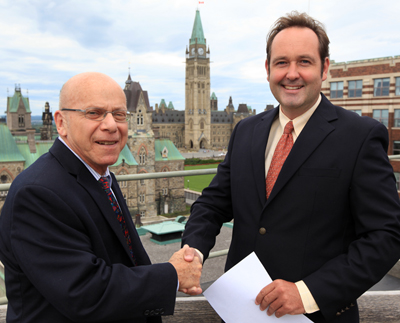
Martin O’Hanlon was sworn in today as Director of CWA Canada although he will not officially begin in the full-time position until Aug. 30. O’Hanlon, 44, is taking a leave from his regular job as parliamentary editor for The Canadian Press, where he continues until the end of this week.

Arnold Amber, the outgoing Director, conducted the official swearing-in of O’Hanlon and Lois Kirkup, 50, who was acclaimed as Deputy Director in May. The president of the Ottawa Newspaper Guild became Treasurer, also by acclamation, a month earlier at the spring meeting of the National Representative Council. Kirkup will serve in both volunteer positions on the executive until a new treasurer can be elected at the next NRC meeting in April 2012.

O’Hanlon, a member of the Canadian Media Guild who last month was declared the winner in national elections, had been Deputy Director for seven years.

“I am looking forward to working with everyone to make this the most progressive and dynamic union in Canada,” said O’Hanlon.

“I’d also like to pay special tribute to Arnold Amber, who steps down after 16 years at the helm of the union. Arnold has been a strong and visionary leader who built CWA|SCA Canada into what it is today. We are grateful for all he’s done and will welcome his ongoing advice.”

Gazette locks out some production workers

Source: The Montreal Gazette


About 20 full-time and a number of part-time employees who work at The Gazette’s production facility on St. Jacques St. in Notre Dame de Grâce were locked out Sunday night after rejecting the company’s final contract offer.

Employees in four other units affiliated with the Teamsters – pressmen, machinist-electricians, paper handlers and building services – approved new contracts in votes on Sunday.

The main stumbling blocks in negotiations between management and its locked-out workers are staffing, working hours and overtime pay.

Bob Pruden, vice-president of labour relations for Postmedia Network Inc., said the previous contract had minimum staffing provisions that are far beyond what is required today, given the changes in the newspaper industry.

“Everybody is aware of the impact that the Internet and new technology like iPads and so on have had on the newspaper business,” he said. “In terms of our circulation, the number of papers we produce and also the advertising in those papers and the advertising inserts have all declined significantly over the last five years covered by the previous collective agreement,” Pruden said on Monday.

Denis Fournier, negotiator for the Teamsters Local 41M, said he was disappointed with the employer’s decision. “Management agreed to leave a four-day week in place for the workers (in the four other units), while requiring the mailing and plate-making workers to work five days a week,” Fournier said.

The locked-out employees include two active members of the platemakers’ unit, positions the company wants to abolish, and fewer than 20 regular, full-time mailers. There are also a number of full-and part-time substitutes in the mailroom who are assigned their shifts by the union.

The Gazette will continue to publish uninterrupted during the lockout.

O’Hanlon wins national vote to head CWA Canada

Source: cwa-scacanada.ca

Martin O’Hanlon will be the next Director of CWA Canada after emerging the clear winner in national elections.

O’Hanlon, a member of the Canadian Media Guild, captured 440 votes. His challenger, Ron Carroll, a copy editor at The Gazette and vice-president of the Montreal Newspaper Guild, garnered 167.

“I’d like to thank the members for putting their trust in me to lead the union,” said O’Hanlon, 44, who has been Deputy Director for seven years. “I promise to do my best to build CWA|SCA Canada into the most dynamic and progressive union in Canada. And I will always put the interests of the members above all else.

“A huge thank you to all who helped with my campaign. There are too many names to list here, but I’ll be in touch with everyone to thank them personally.”

Outgoing Director Arnold Amber congratulated O’Hanlon on his successful campaign. “It’s certainly good that we finally have a declared winner. Now we can move ahead.”

The voting period was twice extended due to the postal dispute. Results were originally expected to be announced on June 27, in time for the winner to be sworn in on July 12 at the 73rd convention of the Communications Workers of America held in Las Vegas.

Amber, who remains as Director until O’Hanlon can assume office, will conduct the swearing-in sometime in the next few weeks. O’Hanlon will be arranging for a leave of absence from his position as parliamentary editor for The Canadian Press in Ottawa.

Amber has been Director of the union since its inception as TNG Canada/CWA in 1995. He noted that O’Hanlon “was there from the beginning” as one of the delegates to the founding meeting.

This was the first time that members of CWA Canada directly voted for Director of the union. Prior to 2008, the Director and Deputy were elected by delegates to the National Representative Council meeting. (Lois Kirkup, president of the Ottawa Newspaper Guild, was acclaimed Deputy Director at this year’s meeting in April.)

Some Locals arranged for in-plant voting while others opted to have members vote by mail-in ballot.

The National Elections Committee, comprising Scott Edmonds, Gord Holder and Nigel Sones, who gathered in Ottawa on Saturday for the official tally, reported there were 65 ballots not counted because they did not conform to the rules. They included 30 unsigned return envelopes, four spoiled ballots and one that was challenged. A procedural error in one Local’s in-plant voting led to another 30 ballots not being counted.


Election 2011 CWA-SCA Canada Director / Notice on Extension of Voting Period

June 28, 2011

To: CWA/SCA Canada Locals and Guild Activists

From: National Elections Committee

Re: 2011 Election for National Director of CWA/SCA Canada

Fellow members,

Because of uncertainty about the resumption of postal service in Canada following the labour dispute at Canada Post, including when the mail already in the system will be moved, the National Elections Committee of CWA/SCA Canada has decided to extend the voting period for the election for the position of National Director.

Ballots must now be received in the designated post office box by the CLOSE OF BUSINESS at the national office of CWA/SCA Canada in Ottawa on FRIDAY, JULY 22, 2011.

Ballots received by that deadline will be COUNTED on SATURDAY, JULY 23, 2011, followed by the announcement of the election results as well as the seven-day period during which protests of the election results may be submitted.

If you have any questions about this election, contact the National Elections Committee through the national office of CWA/SCA Canada:

Unit 7B – 1050 Baxter Road, Ottawa, ON K2C 3P1

Telephone: 613-820-9777

Toll-free: 1-877-486-4292

Email: info@cwa-scacanada.ca

Kingston campaign aims to restore Whig-Standard’s greatness

The GreatWhig.ca team launched the campaign at a news conference in Kingston this morning. From left: Martin O’Hanlon, project initiator and CWA Canada deputy director;Kingston writer Jamie Swift; GreatWhig.ca project manager Alec Ross; CWA Canada Director Arnold Amber; and Paul Schliesmann, Whig-Standard reporter and vice-president of the Kingston Typographical Union.

Souurce: cwa-scacanada.ca

CWA Canada hopes Quebecor responds to pressure

It’s a project the size and likes of which CWA Canada has never before undertaken. The mission? To enjoin an entire community in a campaign to pressure a corporate media giant to restore the quality of its daily newspaper.

An advertising blitz that heralds the launch today of the ambitious multi-media campaign is sure to make the Kingston Whig-Standard the talk of the town, which some time ago dubbed its once highly regarded publication the “Sub” Standard. The message to “Make It Great!” will emanate from billboards, transit ads, radio spots, flyers, the GreatWhig.ca website and a Facebook fan page.

Quebecor chief Pierre Karl Péladeau is about to get an earful from disgruntled readers and advertisers who have lamented the newspaper’s rapid decline under his stewardship. They will be sending email messages and signing a petition that calls on Quebecor to “devote the appropriate resources to the Whig-Standard so that Kingston can once again have a newspaper worthy of our great city.”

Martin O’Hanlon, deputy director of CWA Canada, initiated the project last fall and has overseen its development over the past six months. The executive of the Kingston Typographical Union (KTU), which represents Whig employees, heartily endorsed the plan and connected its architects with community leaders and activists who were quick to embrace the campaign.

“This is about fighting the good fight for quality local news and jobs. It’s not about union versus management; it’s about doing what’s best for everyone,” says O’Hanlon.

“We want to convince Quebecor that investing properly in its newspapers and keeping jobs in the community is good for readers, employees, democracy — and profits.”

Paul Schliesmann, a veteran reporter at the newspaper and vice-president of the KTU, says this is a last-ditch effort: “This project gives me the only hope I have left for the Whig-Standard.”

As the campaign material notes, the Whig-Standard used to be one of Canada’s best small-city newspapers. It won national awards for investigative reporting, offered in-depth coverage of Kingston issues and provided a balanced forum for discussion of matters of local and national importance.

In recent years, and particularly under Quebecor ownership, the qualities that once made the Whig-Standard a source of pride for Kingston have dramatically declined. Readers and advertisers keenly feel the loss.

Petitioners, whose message will go to both Péladeau and Ron Laurin, the newspaper’s publisher, will “request that Quebecor devote the appropriate resources to the Whig-Standard so that Kingston can once again have a newspaper worthy of our great city.”

Alec Ross, a long-time activist in Kingston who cares passionately about the Whig’s status, is co-ordinating the campaign for CWA Canada. A local company was contracted to design and construct the website, which features video testimonials from people in the community who describe the impact of Quebecor’s corporate decisions.

Among those weighing in are Rob Baker of the Tragically Hip, Richard Kizell, chair of the University Hospitals Kingston Foundation, professors, business people, politicians, writers and former Whig reporters.

“Generally,” says Ross, “I chose the video subjects because they are thoughtful, engaged and articulate Whig readers. We have a lot of support from prominent Kingstonians who totally sympathize with the cause, but who — for various reasons — declined to do a video.”

Lawrence Scanlan, who used to work at the Whig, recounts the halcyon days and expresses his sadness for what has been lost. He’s one of many dedicated journalists who recognize that a once proud profession has been undermined by a corporate ownership more interested in proselytizing a political ideology than upholding the public’s interest, a newspaper’s traditional role.

Indeed, Quebecor’s Sun Media has spread its right-wing tentacles into its newspapers and broadcast outlets to espouse its agenda and silence voices of opposition. The chain’s newspapers are filled with articles that spread the gospel and barely reflect the communities they purport to cover.

Centralizing of functions such as subscription services and advertising has eliminated scores of jobs at Sun Media publications and disconnected the publications from the communities they are supposed to serve.

——————————————————————————–

For interviews or more information, contact Martin O’Hanlon (email / 613-867-5090) or Alec Ross (email / 613-572-3182).