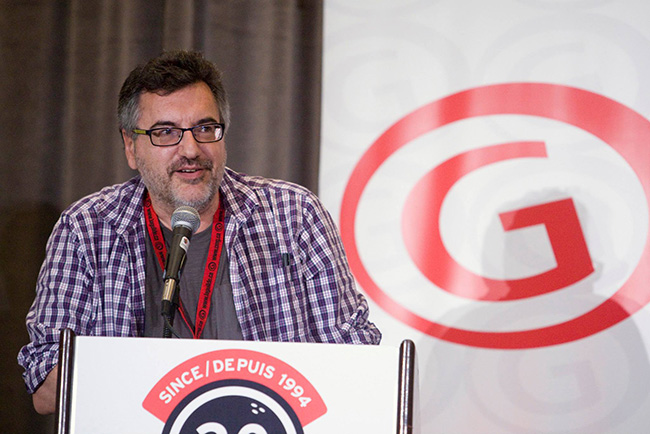
NewsGuild-CWA Condemns Arrest of WV Reporter

This is my job. This is what I’m supposed to do.’

Source http://www.newsguild.org/

Updated May 19, 2017  to include letters of protest.

May 10, 2017 – “The NewsGuild-CWA condemns the arrest of radio reporter Dan Heyman on May 9, 2017,” said President Bernie Lunzer. “This is a chilling attack on the right to report. Every journalist across the country should take notice.”

The arrest is part of a pattern of escalating attacks on the media since the Trump administration took office, Lunzer said, which the union is determined to fight.

“In situations like this, the NewsGuild-CWA stands ready to assist,” he said. The organization is sending letters of protest to the West Virginia Gov. Jim Justice, the West Virginia Capitol Police and the Secret Service, Lunzer said, and is joining with the Reporters Committee for Freedom of the Press and and other news media associations in a letter to the West Virginia Capitol Police.

Heyman’s crime? The reporter for Public News Service persisted in asking Health & Human Services Secretary Tom Price about the Republican health care bill as Price walked through the West Virginia capitol. Price and Kellyanne Conway, Special Counsel to President Trump, were in Charleston to meet with local and state officials and representatives of addiction treatment groups about the opioid crisis in the state, according to the Associated Press.

Watch the video of Heyman’s news conference after his release.

Heyman repeatedly asked Price whether domestic violence would be considered a pre-existing condition under the health care bill, which passed the House on May 4. “In some cases, before the Affordable Care Act, it was a pre-existing condition,” he said, and women who suffered domestic violence were denied coverage.

“This is my job. This is what I’m supposed to do,” Heyman said immediately after his release on $5,000 bail. “I’m supposed to find out if someone is going to be affected by this healthcare law… I think it’s a question that deserves to be answered. I think it’s my job to ask questions and I think it’s my job to try to get answers.”

Heyman said he was recording audio on his phone, which he reached out toward Price, past his staffers, as he walked down the hall. He asked Price the question repeatedly but Price did not answer.

Heyman said he told police officers he was a reporter at the time of the arrest. He was wearing his press credentials over a shirt bearing the Public News Service’s insignia.

He said he thought state police decided he was being “too persistent” in trying to do his job. Heyman was charged with “willful disruption of state government processes.” But he says, “no one who identified themselves as a peace office of any kind – until I was arrested – told me I should not be where I was,” Heyman told reporters.

The West Virginia ACLU and numerous other organizations immediately denounced the arrest. “Today was a dark day for democracy,” the ACLU of West Virginia said. “But the rule of law will prevail. The First Amendment will prevail.”

“This is a highly unusual case,” Heyman’s attorney, Tim DiPiero, said. “I’ve never had a client get arrested for talking too loud or anything similar to that.”

Heyman has been a reporter for about 30 years, with his work appearing in the New York Times, NPR and other national news outlets, he said. He has worked for Public News Service, which provides content to media outlets and publishes its own stories, since 2009.

#Right2Report
#PressFreedom

NewsGuild-CWA Condemns Arrest of WV Reporter

Source: newsguild.org

This is my job. This is what I’m supposed to do.’

May 10, 2017 – “The NewsGuild-CWA condemns the arrest of radio reporter Dan Heyman on May 9, 2017,” said President Bernie Lunzer. “This is a chilling attack on the right to report. Every journalist across the country should take notice.”

The arrest is part of a pattern of escalating attacks on the media since the Trump administration took office, Lunzer said, which the union is determined to fight.

“In situations like this, the NewsGuild-CWA stands ready to assist,” he said. The organization is sending letters of protest to the West Virginia Gov. Jim Justice, the West Virginia Capitol Police and the Secret Service, Lunzer said.

Heyman’s crime? The reporter for Public News Service persisted in asking Health & Human Services Secretary Tom Price about the Republican health care bill as Price walked through the West Virginia state capital. Price and Kellyanne Conway, Special Counsel to President Trump, were in Charleston to meet with local and state officials and representatives of addiction treatment groups about the opioid crisis in the state, according to the Associated Press.

Watch the video of Heyman’s news conference after his release.

Heyman repeatedly asked Price whether domestic violence would be considered a pre-existing condition under the health care bill, which passed the House on May 4. “In some cases, before the Affordable Care Act, it was a pre-existing condition,” he said, and women who suffered domestic violence were denied coverage.

“This is my job. This is what I’m supposed to do,” Heyman said immediately after his release on $5,000 bail. “I’m supposed to find out if someone is going to be affected by this healthcare law… I think it’s a question that deserves to be answered. I think it’s my job to ask questions and I think it’s my job to try to get answers.”

Heyman said he was recording audio on his phone, which he reached out toward Price, past his staffers, as he walked down the hall. He asked Price the question repeatedly but Price did not answer.

Heyman said he told police officers he was a reporter at the time of the arrest. He was wearing his press credentials over a shirt bearing the Public News Service’s insignia.

He said he thought state police decided he was being “too persistent” in trying to do his job. Heyman was charged with “willful disruption of state government processes.” But he says, “no one who identified themselves as a peace office of any kind – until I was arrested – told me I should not be where I was,” Heyman told reporters.

The West Virginia ACLU and numerous other organizations immediately denounced the arrest. “Today was a dark day for democracy,” the ACLU of West Virginia said. “But the rule of law will prevail. The First Amendment will prevail.”

“This is a highly unusual case,” Heyman’s attorney, Tim DiPiero, said. “I’ve never had a client get arrested for talking too loud or anything similar to that.”

Heyman has been a reporter for about 30 years, with his work appearing in the New York Times, NPR and other national news outlets, he said. He has worked for Public News Service, which provides content to media outlets and publishes its own stories, since 2009.

#Right2Report
#PressFreedom

Three Times Colonist reporters have been nominated for a National Newspaper Award

Source – The Times Colonist

Three Times Colonist reporters have been nominated for a National Newspaper Award for their five-day series on the fentanyl overdose crisis in Greater Victoria.

Sarah Petrescu, Katie DeRosa and Louise Dickson were nominated in the project category in the annual awards that recognize excellence in Canadian journalism.

The B.C. Coroners Service has reported that overdoses killed 922 people in 2016. The crisis is continuing this year, with 39 people on Vancouver Island dying of an illicit drug overdose in January and February.

With people dying in their homes, on the streets, in alleys and in public washrooms, Dr. Perry Kendall, provincial health officer, declared a public-health emergency last April.

Also nominated in the project category are a team from the Globe and Mail for stories on soldiers and veterans who died by suicide after serving in Afghanistan, as well as Kristy Kirkup and Sheryl Ubelacker from the Canadian Press for stories of indigenous Canadians terrorized by the emotional and physical impact of sexual abuse.

“We are delighted to be nominated, which is in itself a huge honour,” said Dave Obee, editor-in-chief of the Times Colonist. “This newspaper is consistently ranked with the top newspapers in the country, and we will continue to strive to deliver the best possible newspaper for our readers.”

The Times Colonist nomination is one of three for newspapers in British Columbia.

There are 70 nominations in 21 categories, selected from 959 entries of work published in 2016.

In the local reporting category, Joe Fries of the Penticton Herald was nominated for coverage of how government institutions respond to freedom-of-information requests. In the short feature category, Lori Culbert of the Vancouver Sun and The Province was nominated for a story about a hiking family following a new path after a tragic accident.

The winners will be announced at an awards ceremony in Toronto on May 5.


Altruism fuels union’s fight for unpaid freelancers

DEBORAH RICHMOND | CWA Canada Web Editor

Don Genova has become the ‘go-to guy’ for frustrated freelancers.

There aren’t many unions that would spend time and money to take up the cause of non-members who haven’t been paid for their work. But that’s exactly what the Canadian Media Guild / CWA Canada is doing.

Don Genova, president of the CMG Freelance branch for more than 15 years, is the champion of more than a dozen independent contractors who are owed $40,000 by an Alberta multi-media publisher that has a track record of tardiness when it comes to paying up.

As a result of the efforts by CMG, Genova has become the “go-to guy” for freelancers who face a host of problems ranging from low rates or non-payment to publishers that expect writers to accept contracts that “ask for the moon and the stars.”

When a member contacted Genova early last fall to enlist his help in her quest to wrest payment from Edmonton-based Venture Publishing, he wasn’t surprised. There had been complaints for several years that the company was lax about paying freelancers.

In August last year, CanadaLandShow.com carried an article by Jay Smith, who found two freelance writers who were willing to go on record about the difficulties they encountered trying to get payment from Venture.

Genova suspected there were many more out there. He put word out through The Story Board, a website for freelancers that was an initiative of CMG and the Canadian Writers Group.

“We came up with 13 freelancers who had not been paid, some for up to two years. They were owed a total of more than $40,000,” said Genova.

A freelancer himself, he knew that, as individuals, many are afraid to speak up because it might jeopardize their career. He also knew that the union had to do what was right for these unpaid workers, members or not.

“The point of the exercise is to get them their money, to show them (freelancers) what we can do and that they can have a voice.”

He said the CMG will pursue the case even if the freelancers don’t join the union (although one of them has signed up).

“We’ve already spent quite a bit of money on this and their dues ($150 a year) would not cover our costs.”

Genova started out by discussing the situation with an official at Venture Publishing who admitted the company was slow in paying freelancers. Shortly afterward, the CMG Freelance member got paid as did one other independent writer.

“But there were still 11 people in the group who had not been paid,” said Genova. “And then, out of the woodwork came an illustrator who was owed $8,500.”

He worked with CWA Canada’s legal counsel to craft a demand letter that was sent to the company in November. It is not threatening and suggests possible solutions such as payment plans.

The letter did not produce results, so the CMG issued a news release on Feb. 22 to kick off a name-and-shame campaign that attracted some media coverage. (It also prompted more unpaid freelancers to contact Genova, bringing the total number up to 15.)

At the same time, letters were sent to a handful of companies that contract Venture to produce magazines or other media for them. They are being asked to take their business elsewhere until Venture begins paying freelancers in a timely manner.

The explosion of digital media companies and disruptions in the news industry have led to tremendous growth in the number of freelancers worldwide. What also increased were complaints about exploitative publishers, media companies that try to force bad contracts on freelancers and others that expect them to work for little or no pay.

Media unions such as CWA Canada, which at one time saw freelancers as a threat to their members who were full-time employees with benefits, have done an about-face and now strive to support them.

Genova noted that freelancers who join CMG get a lot in return for their money. They can rely upon experienced staff for advice on contracts and negotiation strategies. Among other things, membership gives them access to lower cost health and insurance benefits, free online training, special webinars and inclusion in a directory available to clients.

CMG Freelance represents hundreds of people who are contracted under the freelance article of the collective agreement with the CBC, as well as about 100 independent writers and artists.

In 2011, CWA Canada created its free Associate Member program that offers student, volunteer and precarious media workers training, workshops, mentoring, networking events and paid freelancing or internship opportunities. Many of the more than 850 associate members move on to join CMG Freelance as they get established in their career.

– See more at: http://www.cwa-scacanada.ca/EN/CWeh/2017/1702_freelancers.shtml#sthash.Fju8bTWr.dpuf

Complaints withdrawn in Halifax dispute; talks to resume

The Halifax Typographical Union and The Chronicle Herald have both withdrawn unfair labour practice complaints related to the year-long work stoppage at the newspaper.

The union that represents 55 striking newsroom workers withdrew its complaint today after the Herald agreed to back away from its bad faith bargaining positions.

“With the Herald changing its position, we have gained everything that we had hoped to achieve through the labour board hearing,” said Ingrid Bulmer, president of the CWA Canada Local. “The hearing became unnecessary.”

The hearing before the Nova Scotia Labour Board was scheduled to begin Monday and continue throughout the entire week.

“We withdrew the complaint to engender bargaining,” Bulmer said. “If the company goes back to its unfair bargaining practices, we reserve the right to refile the complaint.”

The Herald also withdrew its complaint about alleged disclosure of confidential information.

“The Herald accusation did not have any merit and was filed only in retaliation to our complaint,” Bulmer said.

The two sides will return to the bargaining table Tuesday. Bulmer said recent bargaining had been positive and she hopes that continued progress will lead to a deal in the near furture.

– See more at: http://www.cwa-scacanada.ca/EN/releases/170131_ulp_hold.shtml#sthash.QLM3lcxU.dpuf

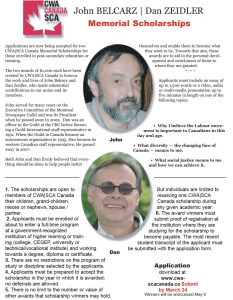
John Belcarz / Dan Zeidler post-secondary education/training memorial scholarships

I am pleased to announce that we are now accepting applications for the John Belcarz / Dan Zeidler post-secondary education/training memorial scholarships. Two scholarships of $1,000 each are available.
The accompanying attachments contain a poster and application form in English and French (also available on our website: http://www.cwa-scacanada.ca). Please circulate this information to your members.
In solidarity,
Martin O’Hanlon
President, CWA/SCA Canada

CWA Joe Beirne Foundation’s scholarship 2017

Dear Local President,

I am pleased to announce that we are now accepting applications for the John Belcarz / Dan Zeidler post-secondary education/training memorial scholarships. Two scholarships of $1,000 each are available.

The accompanying attachments contain a poster and application form in English and French (also available on our website: http://www.cwa-scacanada.ca).
Please circulate this information to your members.
In solidarity,
Martin O’Hanlon
President, CWA/SCA Canada

Print is dead. Long live print.

Source: cjr.org

Photographs by Cara Barer

ROGER FIDLER IS A FOREFATHER of digital journalism. In the early 1980s, he wrote and illustrated an essay on the future of news. When Fidler presented his ideas around Knight Ridder, his co-workers sometimes laughed. “It was not quite like Roger had descended from another planet,” a colleague of his once told me, “but he was saying some things that were simply very hard to believe at the time.”

The idea he spoke of most was one Steve Jobs would have many years later—a tablet on which to read electronic newspapers. Fidler’s design and execution of a prototype were so similar to the eventual iPad that when Apple sued Samsung over design infringements, Samsung used Fidler’s early device to argue the idea was in the public domain.

In Fidler’s vision of the future, news and information were headed to the nascent internet, where stories would be instantly published from one computer to millions more, eliminating the need to operate an expensive press run by expensive workers. A tablet, he thought, was the perfect device to replace paper. Readers could click on boxes that revealed data or more information about a particular subject. Advertisers could produce immersive, interactive ads. And the tablet could be slipped into a briefcase or bag. Fidler was right, of course. Apple has sold several hundred million iPads, and more than a billion phones that serve much the same purpose.

Now, Fidler wonders if he was wrong. “I have come to realize that replicating print in a digital device is much more difficult than what anybody, including me, imagined,” he told me this summer, and he wasn’t just referring to tablets. Fidler is equally concerned about the reading experience and economics of all forms of digital news. Now retired from teaching journalism at the University of Missouri, he has watched newspapers struggle to move their content and business online. The idea of interactive advertising has clearly not panned out, he says. Readers are annoyed and distracted by it, so many block it with browser extensions. He and others have observed that print offers a limited amount of ad space, which is infinite online, driving down ad prices and sending publishers racing around a hamster wheel. To make money, they need more content to advertise against. Some of this content is—how to put this?—lousy, giving readers another reason not to pay for news.


They have killed print, their core product, with all of their focus online.”


Even though his iPad is never far away, Fidler still subscribes to the print editions of The New York Times, the Columbia Daily Tribune and the Columbia Missourian. “I have been wondering,” Fidler says, “whether we have completely underestimated the viability and usefulness of the print product.”

Me too.

I am not a dinosaur; I’m a tech dork who waits in line outside the Apple Store for new iPhones. If my wife ever divorces me, she will testify that I spent too much time on Facebook and Twitter. I’ve been an enthusiastic and vocal supporter of digital news at my workplace, The Washington Post, so much so that my colleagues and bosses might be surprised I’m even posing the following question: What if everything we’ve been led to believe about the future of journalism is wrong?

Two decades have passed since newspapers launched websites, and yet here we are. Big city papers have gone under, thousands of journalists have lost their jobs, and the idea that digital news will eventually become a decent business feels like a rumor. The reality is this: No app, no streamlined website, no “vertical integration,” no social network, no algorithm, no Apple, no Apple Newsstand, no paywall, no soft paywall, no targeted ad, no mobile-first strategy has come close to matching the success of print in revenue or readership. And the most crucial assumption publishers have made about readers, particularly millennials—that they prefer the immediacy of digital—now seems questionable, too.

I wish I were being hyperbolic, but Iris Chyi, a University of Texas associate professor and new media researcher, has been collecting facts to support these assertions. Like me, Chyi is not anti-technology. She enjoys her travels around the Web. While pursuing her PhD in the late 1990s, Chyi conducted audience research for the Austin American-Statesman. But looking at reader metrics nearly a decade later, it became clear to Chyi that online penetration and engagement weren’t growing. This got her wondering, like Fidler, whether newspapers were pursuing a future that would never come.

Chyi began conducting surveys and collecting readership data, analyzing it all in academic papers and a recent book titled, Trial and Error: U.S. Newspapers’ Digital Struggles Toward Inferiority. She has come to believe that the digital shift has been a disaster for media organizations, and that there is no evidence online news will ever be economically or culturally viable. “They have killed print, their core product, with all of their focus online,” Chyi told me in an interview.

To help explain her position, Chyi devised a metaphorical symbol for news online: Ramen noodles. Compared to dinner in a nice restaurant, ramen noodles are an inferior good. They are cheap. You can cook and consume them just about anywhere, including a dorm room sink, in five minutes. To make them profitable, you have to sell them by the metric ton. As for their taste, typing the phrase “Ramen noodles taste like…” into the Google search box produces this result: “Ramen noodles taste like soap.”

In her book, Chyi writes that “the (supposedly dying) print edition still outperforms the (supposedly hopeful) digital product by almost every standard, be it readership, engagement, advertising revenue,” and especially willingness to actually pay for the product. In a paper published earlier this year, Chyi examined data collected by Scarborough, a market research firm owned by Nielsen, for the 51 largest US newspapers, finding that the print edition reaches 28 percent of circulation areas, while the digital version reaches just 10 percent. Digital readers don’t linger. Pew Research Center data shows that readers coming directly to news sites stay less than five minutes. Readers coming from Facebook are gone in less than two minutes.

Publishers argue that print readers are just getting older while younger readers move further away from even considering print, but Pew surveys and Chyi’s analysis of the Scarborough data show that considerable interest in print still persists, even among young readers. Pew reports that print-only is still the most common way of reading news, with more than half of readers last year opting for ink on their hands every day. The percentage who only read news via a computer? Five percent in 2014…and in 2015? Also 5 percent.

Chyi’s findings show that among 18- to 24-year-old news readers, 19.9 percent had read the print edition of a newspaper during the past week. Less than 8 percent read it digitally.

Chyi has been making this argument for several years, but when I spoke to her this past summer she told me that few people in the industry were paying attention, including media reporters. Now they are. Jack Shafer, a sharp media critic at Politico, highlighted her research in an October column on the enduring value of print, but missed the larger context—that her numbers don’t exist in a vacuum. Print is rebounding or stabilizing in other areas of daily life. Sales of print books have risen every year since 2013, while e-books have leveled off and in some genres declined. University students prefer printed textbooks over electronic ones, according to surveys. And independent and used bookstores have made a comeback. Yet as book publishers double down on print—even raising the price of e-books to make paper more attractive—the cost of printed newspapers is going up, not down. Publishers are watering down the lemonade and asking for more quarters. You don’t have to be an economist to see this won’t end well.

It’s undoubtedly true that Americans read less print news year after year. In fairness to the digital gurus, I won’t hide this fact: The number of print newspaper readers has been halved in the last 20 years. But what if the big decline in print readership has more to do with a lack of quality than a lack of interest? By cutting staff, eliminating sections, and moving up deadlines hours (further aging the news before it’s delivered), publishers have communicated that print really is only useful for lining the bottoms of bird cages.

Corporate titans often say that you must be willing to sacrifice your best products to develop new and potentially bigger ones. Apple killed the iPod with the iPhone. We all know how that worked out. But what if newspapers are killing their iPod without an iPhone in sight?

Newspapers still get the vast majority of their revenue from print. Meanwhile, a growing number of online readers use ad blockers, less than 10 percent of readers are willing to pay for more content online, and the digital advertising business stinks—and not just because of the oversupply of ad space. In October, executives at The Guardian bought ads on their own website to see how much money they were left with after Google and the various ad auction companies took their cuts. The result? Thirty cents on the dollar. Given all this, you might think there would be some serious soul searching in the industry. You would be wrong.

Instead, there is evidence that publishers are ignoring the writing on their monitors. Chyi writes in her book that “a well-known newspaper association, which is supposed to inform its members with research relevant to the state of the industry, once declined to publish a research synopsis they invited me to write.” In a letter explaining why, the group told her that because her findings showed that moving to digital might not be the best strategy for newspapers, the organization didn’t want to share them with its members.


Online news…could make it impossible to be informed—even for those who want to be.


Fidler, Chyi, and others concerned about digital news aren’t just worried about the future of journalism; they’re worried about society. In recent years, a flurry of studies has shown that the reading experience online is less immersive and enjoyable than print, which has implications for how we consume and retain information. Studies show that readers tend to skim and jump around online more than they do in print—not just within individual stories, but from page to page and site to site. Print provides a more linear, less distracting way of reading, which in turn increases comprehension

“The cornerstone of democracy,” Thomas Jefferson once wrote, “rests on the foundation of an educated electorate.” But how educated can a society of skimmers really be? A 2013 study in the Newspaper Research Journal found that Times readers recalled more stories and specific details in print than they did online. The study’s authors blamed the poor online results on distractions (ads, links, etc.) and fewer design cues about which articles were newsy and significant. The results are important, the study said, in elucidating “the modern role newspapers play in maintaining an informed citizenry.” The electorate has never been fully informed, but that’s typically by voter choice. Online news, the research says, could make it impossible to be informed—even for those who want to be.

In her book, Chyi quotes a study in which an unnamed newspaper publisher says, “Our website wouldn’t exist if we didn’t have the print edition, because it wouldn’t make money.” The publisher was then asked, “Would the print product exist without the online edition?” The publisher was a bit perplexed. “Now that’s a good question,” he said, “and one that I’m sure has occurred to everybody in our industry: ‘What if we just didn’t do it?’ We are batting our heads against the wall. All the effort that is going into the website is hurting the print edition. Could we just not do it? I don’t know.”

At least one publisher is trying. Michael Gerber is not a scion of the Sulzberger family. He has never worked at a newspaper. He’s a humor writer. Last year, he launched The American Bystander, a humor magazine publishing some of the biggest names in comedy writing, including George Meyer, the genius behind The Simpsons, and cartoonists such as Roz Chast. Gerber has a website, but there is no writing from the magazine on it. The site exists solely to let readers pay for printed copies, which are then mailed to them.

“If you put quality content online, you are tethering it to a business model that is cratering and dying,” Gerber told me, adding that it’s undeniable that “very, very few formerly print publications are better off now than they were prior to the Web.”

The American Bystander is printed on thick paper and looks and feels substantial. The first two issues had more than 100 pages each. Gerber just raised nearly $40,000 for the magazine on Kickstarter. He gets the irony, but “[w]e are going for it,” Gerber says. “We’re going where everyone else isn’t.”

By that, he means paper. He’s placing a bet on the future by choosing the past. “There’s this assumption that online is inevitable, that it is like the steam engine or something,” Gerber says. “Maybe it is. But maybe it’s not. Maybe it can’t be.”

I logged into Kickstarter the other night and made a pledge.

JOURNALISM IS ABOUT REPORTING. Reporting is paying attention and taking good notes. For me, that means using a good pen—a fountain pen. I used to spend a lot of time searching Staples for the best gel pen. I had crushes, but I never fell in love. Then I tried a fountain pen. Love. They glide over the paper. There are a million different ink colors. They aren’t messy. They’re fun to play with. And you can get a great one without spending a fortune. The best part: I find that I pay closer attention to note-taking. Now that’s innovation.

—Michael Rosenwald