Labour Day 2013: Let’s talk about fairness

Martin O’Hanlon

CWA Canada Director

The biggest challenge I find in talking with people about economic, labour and social justice issues is that they get so blinded by ideology, prejudice and ignorance that they can’t focus on the main issue: what’s fair.110520_ohanlon_200x270

When you strip away the labels, politics and prejudices and ask about core issues of fairness and justice, people of all political persuasions have similar opinions.

For example, most conservatives agree with progressives that workers deserve a decent day’s pay for a decent day’s work.

The trouble is that many people get distracted by destructive appeals to emotion — talk of “lazy” workers, “greedy” unions and over-paid bureaucrats — and are unable to see the biggest threat to society: the huge economic inequality out there.

People are more concerned about what their “lazy” neighbour is earning rather than the fact that some companies and billionaires are raking in obscene profits while failing to pay a decent wage — hello Walmart.

Some would rather see laws that restrict unions and workers than laws that raise wages and guarantee fair working conditions.

The implications for society are huge: wealth becomes concentrated in the hands of the 1%, who keep most of it locked away out of the economy, and people are unhappy in their jobs and their lives.

If wages were raised, much of that money would go to workers who would spend it, providing a huge economic boost. And good working conditions mean happier workers and happier families. I think we all agree that’s better for society.

Until people see the Big Picture, overcome their prejudices and ignore those who attack labour for their own selfish gain, we cannot realize our true economic, social and human potential.

That brings us to Labour Day 2013 and a fresh effort to educate Canadians about the vital role unions play in improving society.

On Labour Day, CWA|SCA Canada is joining with the Canadian Labour Congress (CLC) to launch labour’s new “together FAIRNESS WORKS” campaign.

We will help engage millions of union members in conversations about how unions have improved their lives and share their stories with Canadians.

Labour Day isn’t just an opportunity to honour workers with a day off. It is a time to reflect on the many contributions labour makes to building a better country.

Unions have brought about many society-changing improvements: the weekend, the 40-hour work week, medicare, overtime, pensions, health and safety laws, on and on. It is thanks to unions that we can spend time with our families, take a sick day off with pay and live a decent life.

It’s not just about all the huge improvements unions have brought about in the past; it’s about defending what we all enjoy as Canadians and continuing to make society better.

That’s why our union is working hard with the CLC to improve the lives of all Canadians, for example by bolstering the Canada Pension Plan, which will help everyone when they retire regardless of whether they are a union member.

Unfortunately, the good and important work unions do is often ignored. Some in business and politics — whether for profit or political gain — falsely blame unions for problems in our society and economy.

That’s why the “together FAIRNESS WORKS” campaign is so essential. It’s vital that everyone understands how much unions contribute to their prosperity, health, income, safety and security.

Have a Happy Labour Day and please tell everyone that “together FAIRNESS WORKS” – because your union makes your life and your community better!

Let’s fight the good fight, together.


2013 Pittsburgh Convention

pa-2013-convention

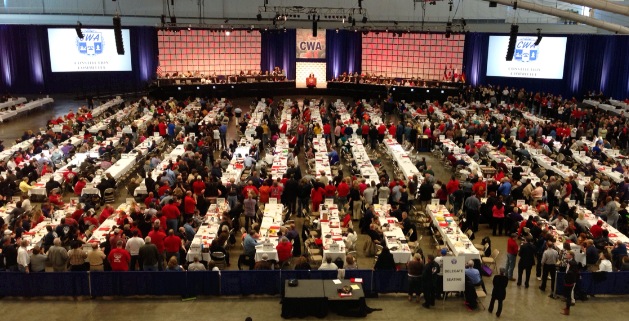
The CWA Convention, and Canadian Locals in attendance, voted overwhelmingly today against a proposal to eliminate proxy voting. So, as per the CWA Constitution, all Locals with less than 200 members will still be allowed to proxy their votes.


Postmedia sees earnings slide

Source: theglobeandmail.com

postmedia-logosPostmedia Network Inc. posted a sharp decrease in earnings in its first quarter, as a surge in digital revenue failed to make up for weak advertising and declining circulation revenues.

Chief executive officer Paul Godfrey doesn’t see things getting better, conceding in an interview that he expects print revenue to continue to decline by about 8 per cent a quarter. The company must cut as much as $80-million out of its operating budget in the next two years and aggressively increase its digital revenue, he said, to help pay down its $464-million debt and to make investments in the areas of the business that are making money.

Click the link to read the entire story @ theglobeandmail.com

Martin O’Hanlon New Years Message

FIGHTING THE GOOD FIGHT IN 2013!

By Martin O’Hanlon
Director, CWA Canada
Download PDF

110520_ohanlon_200x270I made a New Year’s resolution for 2013.

Every day when I get up, I am now asking myself: “What can I do today to make life better for Canadians and make this a better country.”

Not surprisingly, the answer has yet to be: “Cut wages, layoff workers or send jobs overseas.”

However, that’s exactly the answer many businesses choose – and conservatives endorse – in their quest for higher profits.

These are the same people who – as they ruin local economies, devastate workers’ lives, and slash away at the Middle Class – have the audacity to scapegoat unions for what’s wrong with the economy, despite the fact that only a minority of workers belong to a union.

Over the next year, CWA Canada will continue to fight the good fight by standing up and speaking out for quality jobs and quality journalism. We will do that at the bargaining table, through talks with employers, with press releases, and by building coalitions.

2011 saw the rise of “Occupy” and 2012 brought us “Idle No More.” These grassroots movements show that a great many people are fed up with the social and economic injustice in our society and, more importantly, they’re willing to do something about it. We need to support that. We will work with the labour movement, community groups and other progressive organizations to promote the cause of the 99%, stop further job cuts and improve wages.

We enter 2013 full of hope that the worst is over for the media industry and optimistic that the new year will bring more jobs and better journalism.

But, of course, hope and optimism don’t bring change – that takes effort. The challenge will be persuading our employers to invest in a quality product and grow their businesses rather than keep trimming jobs and cutting costs.

One fact has become painfully obvious over the last decade of media slash-and-burn economics: cost-cutting saves money in the short-term, but results in declining revenue in the long-term as readers, listeners and viewers tune out.

Another key challenge for 2103 will be political. As a leader who represents thousands of journalists, I have said repeatedly that I cannot support one political party over another. But that doesn’t mean we must sit idly by and watch injustice or ignore attacks on the interests of our members, the 99%, and democracy.

When a government, political party or any group attacks the common good, we will stand up, speak out and fight back. That’s why we spoke out against the Harper Conservatives when the introduced Bill C-377 – an intrusive, unfair, unnecessary and ideologically motivated piece of rubbish that will cost taxpayers millions of dollars a year to administer and yield no benefit to anyone. Its sole aim is to target unions, tie them up with red tape, and suck out financial and other information for right-wing propaganda.

We will keep up the fight against C-377 and support a court challenge when it receives Royal Assent.

We will also build on our efforts to protect the CBC from further funding cuts – through grassroots campaigns and other actions – so that Canadian public broadcasting can survive and thrive.

And we will step up pressure on the Conservative government to abandon its ideological and mean-spirited plan to push back old age pension benefits until age 67 – a move that steals money from our pockets and will force thousands of Canadians to delay their retirements.

The challenges ahead are many, the hurdles high.

We have two options. We can lie down and hope that a rump Middle Class is still around in a generation.

Or we can fight back!

Let’s work together to protect jobs, defend journalism, improve wages and make this country a better place for all Canadians.

Let’s fight the good fight. Together.

TEXT-S&P cuts Black Press corporate credit rating to ‘B-‘

Source: reuters.com

Tue Nov 6, 2012 3:25pm EST

 Overview

— We are lowering our long-term corporate credit rating on Victoria, B.C.-based Black Press Ltd. to ‘B-‘ from ‘B’ based on our view of the company’s ongoing organic revenue and profit declines, as well as refinancing risk.
— At the same time, we are revising our recovery rating on the company’s senior secured bank debt to ‘1’ from ‘2’, while affirming our ‘B+’ issue-level rating on the debt, reflecting our view of improved recovery prospects given Black Press’ continued repayment of the debt.
— The negative outlook reflects our expectation that we could lower the ratings in the near term if the company fails to address its refinancing risk.

Read entire story

Employees beware: The perils of posting on Facebook

Source: rabble.ca

BY PRIYA SARIN PRO BONO | OCTOBER 25, 2012

The dramatic growth of social media use in Canada on such sites as Facebook has raised novel legal issues for employers and employees. One such issue is whether or not an employee’s off-duty conduct online (i.e. posting personal status updates, photos or comments on Facebook at home) can get that employee fired. In short, the answer is yes.

Many Canadians still erroneously believe that what they post on their personal Facebook page is private. They feel little hesitation in coming home after a difficult day at work and griping publicly about their company, boss, co‑workers or quality of work. While it is important to protect freedom of expression and healthy discourse on labour relations issues, posting this type of content online may have serious consequences.

First, Facebook posts and comments can be produced in a legal proceeding where they might be relevant to the allegations made, even if that information is contained in a limited access area of an individual’s Facebook profile (see Leduc v. Roman [9], at para 31). Moreover, regardless of whether you intend your posts to be relatively private, courts and arbitrators have tended to conclude that posts on social media sites are easily disseminated and may be considered public if viewed by your “friends.”

Second, the current trend in Canada appears to be to uphold discipline and/or dismissals of employees for making inappropriate Facebook posts, namely, any posts which demonstrate insubordination, harassment, breach of any known workplace policy (e.g. on confidentiality, absenteeism, respect for human dignity, etc.), or which could cause harm to the reputation of the employer. These decisions are a wake‑up call to exercise extreme caution in what you post online, even if only to your “friends” on Facebook. This is particularly so where your Facebook friends include past and present co‑workers, or members of the public who could be customers or associates of your employer. It is difficult to predict who will read your comments, or in whose hands they will end up.

This year, arbitrators in both Ontario and Alberta had occasion to consider the circumstances in which they would uphold discipline imposed as a result of offensive Facebook posts made by employees.

In Bell Technical Solutions v. Communications, Energy and Paperworkers Union of Canada [10], Arbitrator Chauvin upheld the suspension of one technician who had made several insulting remarks about his manager on Facebook and upheld the dismissal of another technician who regularly complained about his job and made disparaging comments about both his manager and the company on his Facebook page. A third employee’s discharge was substituted with a one-year suspension without pay for the frequent insulting comments he made about his manager. His dismissal was not upheld because he did not disparage the company and had apparently been provoked by his manager. The comments made by the three employees were viewable by all of their Facebook friends, which specifically included other Bell Technical Solutions technicians. Notably, the manager was not identified by name in the posts but referred to as “gorilla,” which was understood by the employees to refer to their manager.

In coming to his conclusions, Arbitrator Chauvin noted at paragraph 112 of his decision that “the nature and frequency of the comments must be carefully considered to determine how insolent, insulting, insubordinate and/or damaging they were to the individual(s) or the company.” The suspended employee had only made a handful of comments about his manager, removed them once spoken to and ultimately expressed genuine remorse. The dismissed employee, on the other hand, carried on for 16 months making derogatory comments about both his manager and employer without any remorse, even mocking the employer’s requests to cease making these types of comments.

Similarly, in the Canada Post Corp. decision released this past spring (Canada Post Corp. v. Canadian Union of Postal Workers [2012] C.L.A.D. No. 85), Arbitrator Ponak upheld the discharge of a postal clerk with a lengthy 31 years of service because the employee had made a number of vulgar, insulting and threatening comments with respect to her supervisors (e.g. “Die B—- Die” and “I’m texting in sick, my idiot supervisor is 24”). These comments were brought to management’s attention by a co-worker and resulted in the targeted managers taking stress leave from their jobs on seeing the comments. In this case, the employee had not intended her comments to be public, but the arbitrator found she was still responsible for the consequences of her actions.

Notwithstanding Arbitrator Chauvin’s comment in Bell Technical Solutions, highlighting the frequency of inappropriate Facebook comments as a factor to consider, it is important to note that one Facebook post alone could be considered so offensive as to render the employment relationship untenable. This is particularly so if the employee creates a nexus between his or her comments and the employer, and the comments are considered to be public.

For example, in Wasaya Airways LP (Wasaya Airways LP v. Air Line Pilots Assn., International (Wyndels Grievance) (2010), 195 L.A.C. (4th) 1), a pilot with three and a half years of service posted a comment on his Facebook page that was disrespectful to First Nations people. Although he did not identify his employer directly, the post was considered to be so offensive that it undermined the employment relationship. The pilot’s post had the potential to harm Wasaya Airways’ reputation and did poison the pilot’s relationship with management. Indeed, Wasaya Airways is owned by several First Nations and predominantly provides services to First Nations communities. Because of mitigating factors, the pilot was forced to resign instead of being outright dismissed.

Last week, Justin Hutchings of London, Ontario, learned the hard way about the consequences of making an inappropriate Facebook post. Mr. Hutchings posted the offensive comment “Thank God this B—- is Dead” on teen bullying victim Amanda Todd’s memorial page, which was open to the public. Because Mr. Hutchings had identified his employer, Big & Tall Menswear, on his own profile, the employer received a direct complaint about the offensive post. Mr. Hutchings was fired for conduct that was considered contrary to the company’s policy of treating all individuals honourably and, arguably, for conduct that would bring the employer into disrepute. Regardless of whether or not Mr. Hutchings’ dismissal was warranted, let this serve as a reminder that Facebook posts are considered to be very much in the public domain and unsavoury commentary by you that reflects poorly on your employer or colleagues could easily result in negative repercussions for you in the workplace.

Iler Campbell LLP [11] is a law firm serving co-ops, not-for-profits, charities, and socially-minded small business and individuals in Ontario.

Note: Pro Bono provides legal information designed to educate and entertain readers. But legal information is not the same as legal advice — the application of law to an individual’s specific circumstances. While efforts are made to ensure the legal information provided through these columns is useful, we strongly recommend you consult a lawyer for assistance with your particular situation to obtain accurate advice.

Submit requests for future Pro Bono topics to probono@rabble.ca [12]. Read past Pro Bono columns here [13].

Globe’s Oil Sands Advertorial Blurs Lines Public Editor Won’t Discuss

Source: thetyee.ca

Eight pager formatted much like news, but Stead offers slim explanation.

By: By Jonathan Sas, 22 October 2012, TheTyee.ca

View full article and comments: http://thetyee.ca/Mediacheck/2012/10/22/Globe-Oil-Sands-Advertorial/


“Journalism, commercial interests should be kept separate.”

So ran the headline of a post written by the Globe and Mail’s public editor Sylvia Stead on Sept. 27.

In the midst of the uproar over Margaret Wente’s plagiarism, Stead was busy trying to put out another fire, this one over an article from a freelance journalist who had written glowingly about the house she was selling. In this post, Stead concedes that Globe editors had erred in running the story.

The headline, however, speaks to the Globe’s recognition of something broader and ultimately more important: their duty to maintain a clear line between editorial content and the interests of advertisers. One would expect as much from any serious journalistic outlet.

Allowing that line to blur signals a more serious conflict of interest than was printing the real estate article, or failing to be transparent about the misdeeds of a sloppy columnist.

Unfortunately, as careful readers of the Globe might well have noticed, the self-styled “paper of record” has not been living up to its responsibility. Not by a long shot.

read entire story

New contracts at Victoria Times Colonist reflect Glacier Media’s devotion to quality journalism, local production

Source: cwa-scacanada.ca

Negotiations that spanned 18 months and two owners have finally produced new contracts for two CWA Canada Locals that represent workers at the Victoria Times Colonist.

The four-year agreement, which will expire Jan. 2, 2015, includes wage boosts of 1.0 per cent in 2013 and 1.5 per cent in 2014, plus a $250 signing bonus in lieu of retroactive increases.

“We lost nothing,” says a jubilant Chris Carolan, president of the Victoria-Vancouver Island Newspaper Guild (VVING).

“While the gains are modest,” says CWA Canada Director Martin O’Hanlon, “the fact that they avoided concessions in the current newspaper climate is very significant.”

The previous contract, which expired at the start of 2011, had been negotiated when the daily newspaper was owned by Canwest. The chain’s newspapers were acquired by Postmedia Network when Canwest became insolvent. Negotiations with Postmedia began in May 2011, but reached an impasse last September when the employer attempted to reintroduce significant items the joint bargaining council believed had been removed.

Shortly thereafter, Postmedia sold the Colonist to Glacier Media, which publishes more than 60 community newspapers, primarily in Western Canada.

Carolan says it became obvious after a meeting earlier this year between the three unions and Orest Smysnuik, the company’s chief financial officer, that Glacier Media was interested in reaching a fair agreement that both sides could live with.

When bargaining resumed, “we accomplished more in three days than we did in the previous 18 months, which tells us our new employer is eager to grow the company at the local level, rather than offshore,” says Carolan.

Members of VVING, which represents 153 employees in editorial, advertising, circulation, maintenance, information technology and business departments, voted 96 per cent in favour of ratifying the tentative agreement. Members of British Columbia Local 30404, which represents 35 workers in the mailroom, voted 92 per cent in favour. Members of CEP, which represents workers in composing and the pressroom, also voted with large majorities to accept the deal.

Carolan and O’Hanlon had expressed their “cautious optimism” in a news release welcoming the ownership change a year ago, saying they were “heartened by statements Glacier has made in the past about quality journalism.” Glacier had lamented in an annual report that “the demise of many North American newspaper and media companies has in part been self-inflicted. The Internet has been a factor, but the reduction of content and quality through continual cost cutting has played a significant role.”

Paul Godfrey, CEO of Postmedia, which has slashed jobs and sacrificed quality at all of its metro dailies in order to service a huge debt load, told the Globe and Mail the Victoria paper’s union rules were also a motivator for the sale. (Their contract prevents outsourcing services such as pagination.) He claimed that employees hadn’t bought into the company’s “Digital First philosophy.”

Carolan countered at the time that his members simply objected to the centralization of pagination in Hamilton and ad production in the Phillippines: “We bought into Digital First, we just didn’t buy into shipping our jobs to Manila, Dominican Republic, Hamilton, Calgary, etc.”

He observes now that “the atmosphere for the most part at the negotiating table with Glacier was a pleasant surprise compared to the earlier negotiations when Postmedia was our owner.

“We also understand that our industry is changing at a rapid pace and we believe we can work with the company within the parameters of our newly signed four-year collective agreement to address any concerns that may occur.”

The Orange County Register is hiring dozens of reporters, focusing on print-first expansion

Source: niemanlab.org

After being sold over the summer, the newspaper is hiring about 50 editorial staffers and adding new print sections — because print’s where the money is.

Why did the Orange County Register send reporters and photogs to cover 40 — yes, four-zero, 40 — high-school sporting events in one weekend?

No, it’s not another news mob. Nor is it a one-time thing. At a time when many newspaper companies are starting to think digital first, the Register is investing in print.

read entire story