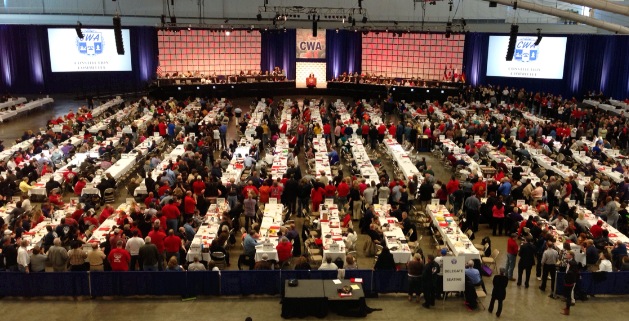
The CWA Convention, and Canadian Locals in attendance, voted overwhelmingly today against a proposal to eliminate proxy voting. So, as per the CWA Constitution, all Locals with less than 200 members will still be allowed to proxy their votes.
The CWA Convention, and Canadian Locals in attendance, voted overwhelmingly today against a proposal to eliminate proxy voting. So, as per the CWA Constitution, all Locals with less than 200 members will still be allowed to proxy their votes.
Source: theglobeandmail.com
Losses deepened at Postmedia Network Canada Corp. in the last quarter, as national and classified advertising in its newspapers continued to decline.
The publisher –which owns such big-city metros such as the Ottawa Citizen, Montreal Gazette and Calgary Herald in addition to the National Post – said it lost $14.2-million in its second quarter, compared with $11.1-million a year ago.
 Union Privilege and the AFL-CIO have announced a new scholarship program to commemorate the 50th anniversary of the March on Washington. The one-time, $5,000 scholarships are for study for the academic year beginning in the fall of 2013 through summer 2014. They will be awarded to at least 50 talented high school seniors to help pay for the costs of higher education.
On August 28, 1963, Dr. Martin Luther King, Jr., gave his “I Have a Dream” speech as part of that historic March on Washington. This scholarship program honors the legacy of Dr. King’s speech and his dream that all of America’s children could have equal access and equal opportunity.
An application, including an essay, is required. The application deadline is July 1, 2013. For more information and to apply online, click here
Source: sgnews.ca
by Ann Douglas
Three weeks ago, I was confronted with one of the most difficult decisions I have had to make in my career as a freelance writer: sign a highly objectionable freelance writing agreement or stop writing a column I loved.
In mid-February, I was presented with a copy of The Toronto Star’s freelance agreement — an agreement that, among other things, asked me to permit The Toronto Star, its affiliates, and unspecified “others” to reuse my work without any additional compensation to me (and without my having any control over who those others might be and how they might choose to use my work):
1. In consideration of the fee paid by the Publisher for a particular Work, the Freelancer hereby grants to the Publisher and to each of its affiliates, an irrevocable, perpetual, worldwide, royalty-free non-exclusive license to:
(i) publish, communicate to the public and distribute copies of the Work in any publications or properties of the Publisher or any of its affiliates; and
(ii) reproduce, publish, republish, compile, prepare derivative works from the Work (including use of the Work for marketing purposes by the Publisher and its affiliates) and, so long as such rights are exercised either (A) in association with the name of the Freelancer and the Publisher (or its affiliates, as applicable) or (B) as part of a database or archive of any of the publications or properties in (i) above or in products derived from any of them, sub-license or authorize others to exercise the above rights in this paragraph 1, in any medium, context or form whatsoever, and by any means or technology, whether now known or developed in the future.
I was most concerned about allowing The Toronto Star to license my work to third parties. Over the years, I have turned down at least $75,000 worth of work from infant formula companies because I do not wish to do anything that would undercut breastfeeding. I have also turned down the opportunity to work with a number of other companies who represent other types of products and services. Therefore, signing the agreement “as is” simply wasn’t an option for me.
Despite my attempts to find some mutually acceptable common ground, I quickly discovered that The Toronto Star was not open to negotiating the terms of its freelance agreement. The agreement had to be signed “as is” — and before my next column could be published.
I chose not to sign.
As these things go, I’m relatively lucky:
All that said, I can’t help but feel frustrated by the way things turned out. The word “agreement” implies that the two parties have had some sort of discussion and have found some common ground. That simply never happened in this situation. The “freelance agreement” was presented to me as a fait accompli: something to be signed — or not.
As I noted in the letter of resignation which I submitted to Toronto Star publisher John Cruikshank:
I have spent the past week trying to negotiate the terms of The Star‘s freelance agreement with various members of your staff.
Unfortunately, I have been told that the agreement must be signed “as is”—that there is no room for negotiation.
For the reasons outlined [elsewhere], that is simply not an option for me.
I loved having the opportunity to write for The Toronto Star. I was proud to be associated with a newspaperfounded on principles of social justice.
And parents loved reading my columns in The Toronto Star. (I have a loyal following of Canadian readers, having sold 500,000 copies of the books in my pregnancy and parenting book series.)
I am disappointed that Toronto’s most progressive daily newspaper chose to act arbitrarily rather than progressively in dealing with my very legitimate contract concerns.
I have been left with no alternative but to give up a column that I loved writing and that was highly valued by Toronto Star readers.
Rather than ending up with the win-win I hoped to negotiate, we are each left with a lose-lose.
I know this won’t be the last time I have to push back hard against an unacceptable freelance agreement this year. (I’m already aware of at least one more contract battle I’ll be fighting.) I also know that the only way we’re going to prevent the continued deterioration of working conditions in our industry (to the point where writing becomes a quaint hobby as opposed to a respected profession) is by standing firm, shoulder to shoulder. I’m willing to take that stand with my fellow writers. How about you?
[Update/editor’s note: The Canadian Media Guild is still collecting signatures on its letter from freelancers protesting the Toronto Star’s contributor agreement. To see the letter — and find out how many have signed so far — please email Jean Broughton at jean@cmg.ca.]
Ann Douglas is an author, magazine writer, and a past president of the Professional Writers Association of Canada (PWAC). She lives in Peterborough, Ontario. Her website is www.anndouglas.ca.
This blog post appeared on Story Board
|
Source CMG • POSTED ON February 20, 2013
|
Transcontinental Media, publisher of magazines such as Elle Canada and The Hockey News as well as dozens of community newspapers across the country, is trying to impose a harsh new contract on freelancers. The conditions Transcontinental is seeking undermine everyone in the sector.
Transcontinental wants the same rights it gets for the work of employees and highly-paid contractors. The catch? It wants to keep paying low editorial freelance rates.
Freelancers are being asked to sign over all rights to the pieces they contribute, on all platforms and all brands the company owns, in all countries, forever. Transcontinental is also seeking the right to change the work in any way it wants and either leave the freelancer’s byline off – or, perhaps worse, leave it on.
Please spread the word about this – especially if you know anyone who freelances for Transcontinental. The Guild is organizing with fed-up freelancers to fix the contract. Write to Keith Maskell (keith@cmg.ca).
There’s more to this story, which you can find on Story Board here.
Source: mediaunion.ca
Bargaining between Local 2000 and Black Press Lower Mainland was suspended Tuesday after company negotiators, for the second time, presented the union with a proposal for a five-year contract with no general wage increases.
The company has proposed a one-time lump sum payment of 1% effective April 1, 2013, but only to employees at the top of their pay scale, prorated on an employee’s fulltime equivalency. In addition the company has proposed a one-time lump sum payment of 1.5% effective April 1, 2014, but only to employees at the top of their pay scale, prorated on an employee’s fulltime equivalency.
Under this company proposal there would be no general increases to the wage grid in the five-year period between April 1, 2010 and March 31, 2015.
The company is saying it needs this freeze in the wage grid in order to compete with wages paid at Glacier Media.
The company did agree to getting rid of the bottom rung of the bindery wage grid, which would have the effect of changing the starting rate from $10.58 per hour to $12.08 per hour. This would only affect new bindery employees and those currently paid $10.58 per hour.
The company also agreed to change the Shipper/Receiver rate to the same grid as General Clerk. This change would see the top rate for that job increasing from $17.98 per hour (after 2 years) to $19.74 per hour (after 4 years).
Under the company proposal there would also be a few minor concessions. The joint composing room board for Tri-City/Maple Ridge/Burnaby/New West would be split into three boards. As well the company is asking for a weakening of our “hot goods” clause in the contract.
Your bargaining committee believes the company’s general wage proposal to be unacceptable. It has decided to spend the next two weeks consulting with the membership.
Please email Vice President Gary Engler at gengler@mediaunion.ca with your comments or questions or talk to one of the bargaining committee members.
Members of your bargaining committee are:
Debbie Irvine — Abbotsford bindery
Jessica Unger — Campbell Heights bindery
Channy Dhillon — Abbotsford pressroom
Eileen Jarrett — Peace Arch News composing
Rich Weldon — Langley composing
Bonnie Pierotti — Abbotsford classified
Phil Melnychuk — Maple Ridge editorial
Source: j-source.ca
Kim Covert remembers the “dead silence,” broken by muffled crying.
She and two dozen other copy editors were clumped around the large central table in Postmedia Network Inc.’s newswire office in Ottawa. The group, which gathered national and international news and copy edited it for use in Postmedia newspapers across the country, gaped at the company’s vice-president of editorial operations, Lou Clancy, as he announced Canadian Press was taking over their jobs. It was cheaper; they were fired.
“We all kind of looked at each other and thought, ‘What the fuck?’ because most of us hadn’t expected any such thing,” says Covert. “My first thought was, ‘Oh my God, my mortgage,’ and my stomach just fell.”
Source: theglobeandmail.com
Value investors are thrifty folk who have a natural affinity for like-minded people. They detest CEOs who live it up on the backs of shareholders.
Click here to read entire story
Source: editorandpublisher.com
by: Alan D. Mutter
Several years ago, The Washington Post convened a series of focus groups to learn why most people younger than 45 did not subscribe to the newspaper — a problem persisting to this day throughout the overwhelmingly print-centric industry.
It’s not that people didn’t like the Post, reported the American Journalism Review in a 2005 article describing the research project. The problem was that the respondents — many of whom happily consumed news on digital devices — drew the line at piles of old newspapers cluttering up their lives. According to a Post executive quoted by the AJR, more than one respondent declared: “I don’t want that hulking thing in my house.”
Source: thetyee.ca
By ROBYN SMITH
A former managing editor of the Vancouver Sun is the new president and publisher of the newspaper, as well as The Province, it was announced today.
Gordon Fisher, most recently the president of the National Post, will now oversee the Pacific Newspaper Group, the company that manages the major B.C. dailies.
“A major focus of this year’s business strategy is to redefine our organization and today we announced changes to the senior management group,” wrote Postmedia CEO Paul Godfrey in a statement. “I have great confidence that Gord will be able to parlay the successes he has had in Eastern Canada and bring his insights and passion to our BC operations.”
Fisher succeeds Kevin Bent, who’s held the job since 2006 but is now leaving to pursue other opportunities, according to Godfrey’s statement.
Postmedia suffered a decrease in its first quarter earnings, the Globe and Mailreported last week. To pay down debt and invest in profitable areas of the business, Godfrey said the company must cut up to $80 million out of its operating budget over the next two years, as well as boost digital revenue.
Today’s announcement follows discussions among senior management about sharing content between the two newspapers. On Jan. 17, The Province’s editor-in-chief Wayne Moriarty sent an email to the paper’s editorial team about some of those discussions, which The Tyee obtained. We reprint some of that email below:
“The Province and The Sun have pooled resources and shared a photo department since January 2010. This eliminated duplication — those occasions when each paper dispatched photographers to the same news events, games, concerts, meetings and other assignments. The move also enabled a rationalization of assignment staffing, with one editor from each paper able to cover the department around the clock.
“The papers centralized the assignment and editing functions for both newsrooms’ production of Travel, Driving, New Homes, At Home, and Recreational Properties. The Specialty Publications department works closely with advertisers to produce copy for both papers, with an office and supervision that is completely separate from the two newsrooms, and more closely allied with Advertising and the Creative departments.
“For special events the two newsrooms have combined staffing in order to eliminate duplication and increase the volume of content online and in the papers, including the 2010 Olympics, and provincial and civic elections.
“On Wednesday [Jan. 16], section heads and senior management from both papers met to discuss the next step in sharing content. The three areas most affected will be city, sports and entertainment. The objective is to eliminate some duplication in areas around commodity news and event coverage. Excluded from the sharing strategy will be all enterprise reporting and reporting that either paper deems necessary to maintain its unique identity.”
Robyn Smith reports for The Tyee.